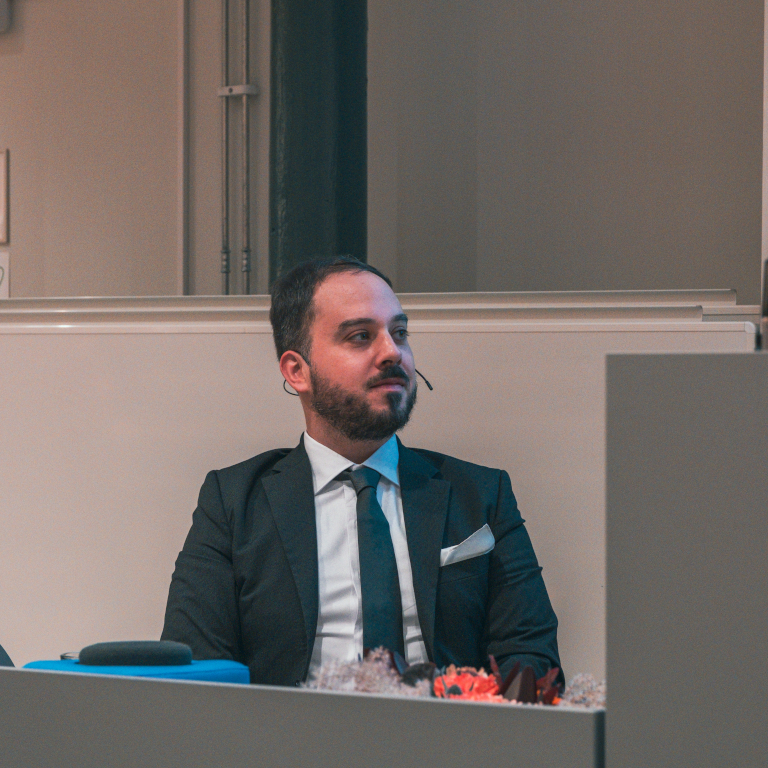
 I'm a postdoctoral researcher at the
Institute for Analytical Sociology (IAS)
at Linköping University, Sweden.
I'm a postdoctoral researcher at the
Institute for Analytical Sociology (IAS)
at Linköping University, Sweden.
I primarily study legislative debates, how elected officials talk with
each other in parliaments, and how this relates to their voting behavior.
I analyze mechanisms of policymaking and how political regimes change
based on what issues politicians talk about and vote on. To do so, I
approach large parliamentary corpora such as the Congressional Record
using large-scale text analysis.
Curriculum Vitae (PDF)
Political Sociology • Computational Social Science • Analytical Sociology • Computational Text Analysis/NLP • Legislative Debates • Policymaking • U.S. Congress • Science of Science • Ethics of AI
Currently, I am involved in studying three distinct corpora: German and Swedish parliamentary debates to study discursive polarization; a corpus on computer science Security & Privacy research to study ethical behavior; and one on Swedish folkhögskolan to study how these schools have reacted to, and shaped large social shifts throughout the longue durée.
Academic Research
I am affiliated with the Institute for Analytical Sociology (IAS), Linköping University, Sweden. My research intersects with political and economic sociology, text analysis and computational social science. Find out at which conferences I'll be this year, and see my blog for bits and pieces on everything academic.
Conferences 2026
Tap to view detailsMost Recent Article: WebGL Series, Part 3: Drawing Things
Published January 23rd, 2026
Abstract: In this third installment of my 8-part series on WebGL, I explain how I finally was able to draw triangles onto the screen, based on the previous two articles that were merely concerned with setting things up.
Open Source development
When I'm not analyzing policymaking and individual behavior in parliaments, I advocate for Open Source. Since at least 2006 I have been a user, supporter, and contributor to Free and Open Source Software (FOSS).
My main project is Zettlr. It is a "one-stop publication workbench" targeted at students and researchers in the arts and humanities. I started working on it in 2017 and have been the project lead ever since.
After the Twitter-exodus began, I started the go-to list for finding your peers, Academics on Mastodon. It lists hundreds of people from dozens of fields and Mastodon instances so that you can orient yourself in this new social media.
You can find more info on my involvement with software on my GitHub profile.